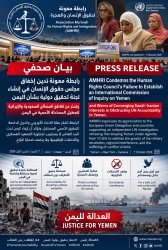
AMHRI Condemns UN Failure on Yemen Accountability
AMHRI expresses its appreciation to the European Union Delegation and countries supporting an independent UN investigation, stressing that keeping Yemen under Agenda Item 10 fails to address the gravity of the military escalation, regional interference, and the suffering of conflict victims.
Yemen – New York – Geneva | 7 October 2026
The Association Ma’onah for Human Rights and Immigration (AMHRI) expresses its profound disappointment and condemnation of the United Nations Human Rights Council’s failure, at the conclusion of its sixty-third regular session in Geneva on 7 October 2026, to respond to its calls for the establishment of an independent, impartial, and comprehensive United Nations commission of inquiry and fact-finding mechanism to investigate all war crimes, grave violations, and acts of terrorism committed in Yemen, and to ensure accountability for all parties involved, whether domestic Yemeni actors or implicated regional and external States and entities.
AMHRI deeply regrets the Human Rights Council’s adoption, on 7 October 2026, of the draft resolution submitted by Iraq on behalf of the Arab Group concerning Yemen, which maintains the situation under Agenda Item 10 on technical assistance and capacity-building and continues support for the National Commission of Inquiry, without establishing an independent international mechanism with a comprehensive mandate to investigate violations, collect and preserve evidence, and determine responsibility for the abuses committed.
AMHRI considers the resolution adopted today a missed opportunity to deliver justice to Yemeni victims and combat impunity. It reflects the continuation of an international approach that is no longer commensurate with the seriousness of the rapidly escalating military, humanitarian, and regional developments in Yemen and the wider region.
I. Condemnation of Converging Saudi–Iranian Interests in Frustrating Calls for a UN Investigation into Yemen
AMHRI strongly condemns the convergence of Saudi and Iranian positions in support of maintaining Yemen under Agenda Item 10 and relying exclusively on the national investigative mechanism affiliated with the Saudi-backed Yemeni Government, rather than establishing an independent and comprehensive international commission of inquiry.
AMHRI believes that this convergence of interests, notwithstanding the conflicting agendas of the two States and their competition for influence in Yemen, raises serious concerns about a shared interest in preventing the establishment of a UN investigative mechanism whose mandate could extend to examining the military, political, financial, and operational roles of both the Kingdom of Saudi Arabia and the Islamic Republic of Iran, as well as the responsibility of entities and individuals whose involvement in grave violations may be established.
AMHRI warns that the continuation of this approach could, in practice, provide political and legal protection against international accountability and prevent impartial investigations into the responsibility of regional actors for violations committed in Yemen.
The Association emphasizes that its assessment of this convergence of interests constitutes a human rights and political evaluation of the two States’ positions, noting that the Council adopted the resolution without a recorded vote.
AMHRI rejects any transformation of Saudi–Iranian rivalry in Yemen into a convergence aimed at obstructing justice for Yemenis, or any situation in which the rights of Yemeni victims become hostage to regional understandings and the political interests of the two States involved in the conflict.
II. Escalation in Yemen Requires Investigation of All Domestic and External Parties
AMHRI affirms that its daily human rights monitoring reports issued during September and October 2026 documented escalating armed confrontations in Taiz, Marib, Hudaydah, Lahj, the western coast, and the Bab al-Mandab area, alongside increasing displacement and casualties, reports of attacks affecting civilian areas, displacement camps, and critical infrastructure, as well as an expansion of cross-border attacks and threats to the safety and security of international navigation.
AMHRI notes that the monitoring data on which it relied through the end of September indicated more than 4,481 reported casualties, including 838 deaths, and displacement exceeding 148,000 people, based on the different reporting periods and methodologies of the humanitarian sources consulted by the Association. These figures underscore the gravity of the crisis and the urgent need to strengthen international protection for civilians.
AMHRI condemns violations attributed to the Iran-backed Houthi movement, including attacks against civilians and displaced persons, the arbitrary detention of United Nations and humanitarian personnel, and cross-border missile attacks. It also calls for independent investigations into airstrikes and military operations attributed to government forces and Saudi-backed forces, as well as any violations committed by locally armed formations supported by them.
The Association stresses that the mandate of the proposed UN investigation must encompass the Houthi movement, the internationally recognized Yemeni Government and its affiliated forces, and all other armed formations. It must also examine the potential roles of the Kingdom of Saudi Arabia, the Islamic Republic of Iran, and any other external actors, including alleged involvement by Türkiye, Pakistan, and Iraq, wherever evidence exists warranting an examination of their legal responsibility.
AMHRI reiterates its support for the legitimacy and sovereignty of the Yemeni State in accordance with the country’s Constitution and its rejection of the Houthi coup and its consequences. It likewise rejects any external intervention that imposes political leadership on Yemen contrary to the will of its people and outside its constitutional institutions.
The Association emphasizes that supporting the legitimacy of the Yemeni State does not confer immunity from investigation, that rejecting the Houthi coup cannot justify overlooking violations committed by other parties, and that international justice must apply to all without selectivity or exception.
III. AMHRI’s Oral Statement Before the Human Rights Council on 5 October
AMHRI recalls that it explicitly warned the Human Rights Council against the dangers of relying solely on technical assistance in its oral statement delivered on 5 October 2026 during the general debate under Agenda Item 10 by its representative, Ms. Noura Al-Jarawi.
The statement emphasized that the Arab draft resolution on Yemen failed to address the accountability and investigation gap, and that continued support for the National Commission, notwithstanding the importance of strengthening its capacities, could not substitute for an independent UN mechanism with a mandate covering violations committed by all Yemeni and regional parties to the conflict.
AMHRI also urged the Council to move beyond an approach limited to technical assistance and respond to the serious developments in Yemen and the region by establishing a comprehensive international fact-finding and investigative commission empowered to preserve evidence, protect witnesses, and secure justice and redress for victims.
This oral intervention formed part of AMHRI’s broader engagement throughout the sixty-third session, including its official written statements and memoranda addressed to the United Nations High Commissioner for Human Rights and permanent missions, emphasizing the urgent need to close the international accountability gap in Yemen.
IV. Appreciation for the European Union and States Supporting Accountability
AMHRI extends its sincere gratitude and appreciation to the Delegation of the European Union to the United Nations in Geneva and to the Member States that supported strengthening independent international monitoring and accountability in Yemen and expressed objections to the Arab draft resolution’s failure to adequately meet the requirements of human rights protection and justice for victims.
The Association particularly commends the position of the European Union Delegation, which expressed profound disappointment with the draft resolution and emphasized the need for greater international attention to the situation in Yemen, independent monitoring of violations, and accountability for those responsible.
AMHRI also extends its appreciation to the Permanent Missions of Switzerland, the Netherlands, Denmark, Albania, and Estonia.
AMHRI considers these positions substantively consistent with the demands it presented before the Council and calls upon the European Union and States supporting accountability to continue their diplomatic efforts toward introducing a new draft resolution establishing an independent and comprehensive United Nations investigative mechanism for Yemen.
V. AMHRI’s Demands Following the Failure of the Sixty-Third Session
AMHRI calls upon the Human Rights Council, the United Nations High Commissioner for Human Rights, and Member States to revisit the question of international investigation and accountability in Yemen at the earliest possible opportunity, including by convening a special session of the Council, and to take the following measures:
1. Establish an independent, impartial, and comprehensive UN commission of inquiry and fact-finding mechanism to investigate grave violations committed in Yemen, with consideration given to addressing the situation under Agenda Item 2 of the Human Rights Council.
2. Ensure that investigations encompass all Yemeni, regional, and external parties without exception, including the roles of Saudi Arabia, Iran, and other States or entities where evidence exists indicating responsibility for any violations.
3. Provide the international mechanism with a clear mandate to collect, preserve, and analyze evidence and protect victims and witnesses, with a view to facilitating judicial accountability and reparations.
4. Ensure that technical assistance, political settlements, or regional understandings are not used as substitutes for independent international investigations, or as means of shielding individuals or States implicated in international crimes from accountability.
5. Bring an end to external interference that undermines Yemen’s sovereign decision-making, while ensuring accountability for violations committed by all parties.
Concluding Position
The Association Ma’onah for Human Rights and Immigration affirms that the resolution adopted by the Human Rights Council at its sixty-third session failed to respond to the fundamental demand of Yemeni victims for an independent and comprehensive United Nations commission of inquiry under Agenda Item 2, and that maintaining Yemen under Agenda Item 10 must not become a cover for continued impunity.
AMHRI stresses that Yemen must not be treated as a battleground for settling regional rivalries, and that its sovereignty and the rights of its people must never become bargaining chips among regional powers involved in the conflict.
Justice for the victims of Yemen cannot be achieved by investigating one party while exempting another, nor by extending mechanisms with limited mandates. It requires an independent UN mechanism capable of uncovering the truth, preserving evidence, and ensuring accountability for every individual or entity found responsible, whether Yemeni, Saudi, Iranian, or affiliated with any other State or actor.
AMHRI pledges to continue its human rights advocacy before the United Nations and in cooperation with its international partners until fair and comprehensive accountability is achieved for all those responsible for grave violations in Yemen.
Issued by:
Association Ma’onah for Human Rights and Immigration (AMHRI)
New York – Geneva – Yemen
#JusticeForYemen #YemenAccountability #IndependentInvestigationForYemen
